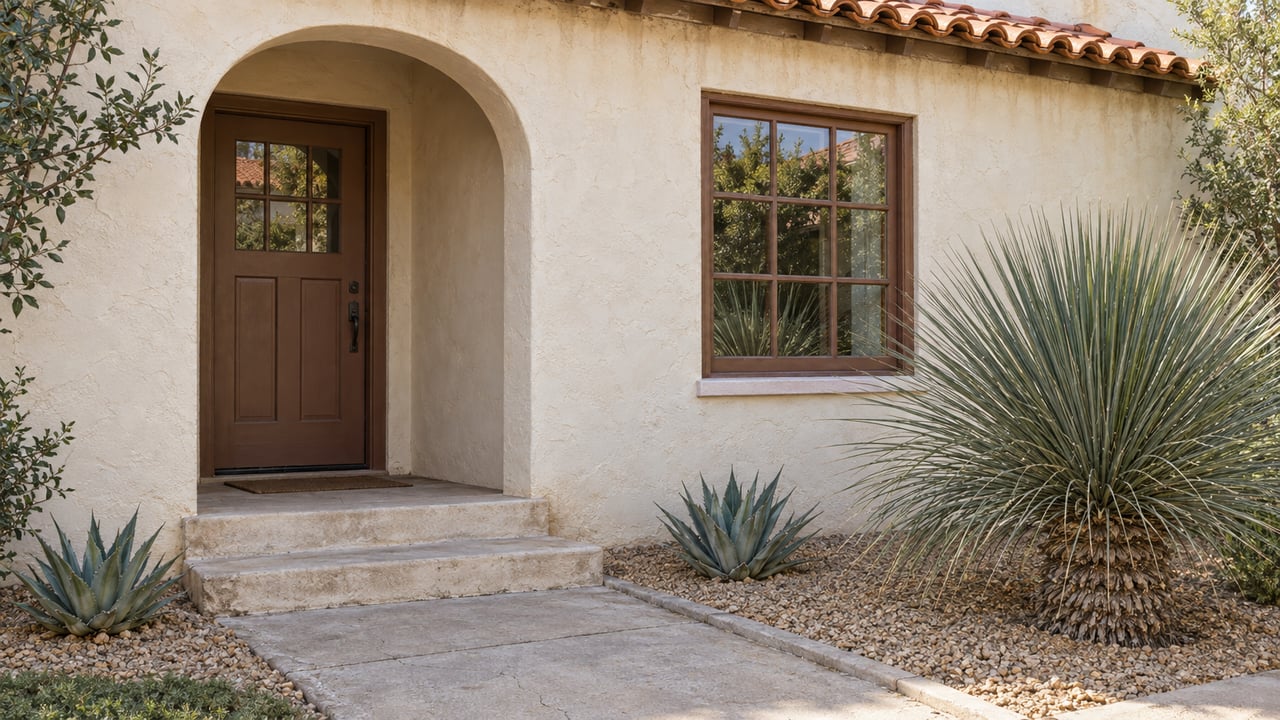
"If your neighbor has a metal roof and you have a barrel tile roof, you do not automatically get a metal roof because your neighbor has one." That line came from Providencia Velázquez, El Paso's Historic Preservation Officer, explaining to the Historic Landmark Commission why one homeowner's roofing request didn't set a precedent for the whole block.
It sounds like a small distinction. For anyone about to close on a home in one of Central El Paso's historic districts, it's the difference between a weekend re-roofing job and a months-long approval process that starts before the building permit does.
Historic charm and historic designation aren't the same thing
Central El Paso gets marketed as one big historic pocket. Kern Place, Sunset Heights, Manhattan Heights all show up in listing copy with some version of the same phrase: character, charm, walkable streets, homes with history. That language is accurate for the housing stock. It's misleading about the rules.
The city has nine locally designated historic districts, each with its own interactive map on the Planning and Inspections page: Austin Terrace, Chihuahuita, Downtown, Magoffin, Manhattan Heights, Mission Trail, Old San Francisco, Sunset Heights, and Ysleta. Kern Place, despite carrying the historic label in nearly every listing description written about it, does not appear on that list.
Same decade of construction, same stucco-and-brick look, completely different rulebook once you own it.
This matters most at the offer stage, because a district boundary rarely shows up in a listing photo. The only way to know which side of the line a property sits on is to check the city's district map by address or call the Historic Preservation Office directly, before writing anything into a contract that assumes you can touch the exterior on your own timeline.
What "before" actually means
For property inside one of the nine districts, the rule is specific: the City of El Paso's historic-preservation FAQ says a Certificate of Appropriateness, or COA, has to be issued before a building permit can be granted for any alteration, rehabilitation, construction, reconstruction, or demolition affecting a landmark structure or site. Not after. Before.
The list of projects that trigger a COA review reads like ordinary homeowner maintenance rather than a construction project: landscaping changes, painting, re-roofing, repair of walks and driveways, fence work, window and door replacement. Some of these get handled through an Administrative Review by Historic Preservation Office staff. Larger or more visible changes go to the full Historic Landmark Commission for a public hearing.
Either path runs on the same standard. Staff apply the design guidelines adopted for that specific district. If a district has no adopted guidelines yet, staff borrow from the district most similar in character, materials, and construction era. If that still doesn't cover the situation, the Secretary of the Interior's Standards for Rehabilitation apply. There's a built-in answer for nearly every scenario, which is exactly why staff can and do say no to requests that don't fit.
One reassurance worth stating plainly: designation only governs appearance, not use. The city's own guidance is direct on this point. Whatever your zoning already permits on the property stays permitted. A historic designation changes what a house can look like from the street. It does not change what you're allowed to do inside it or with it.
What the commission actually approved this year
The theory reads as bureaucratic until you see it applied to real addresses.
In May 2026, the commission approved a Certificate of Appropriateness for a rear carport and pergola at 517 Corto Way in Sunset Heights, a house dating to around 1904. Staff recommended approval because the additions sat at the rear and alley, out of view from the main facade, and used compatible materials. No historic fabric was removed. That's the kind of request that clears review without much friction, because the owner designed around the guidelines from the start.
Contrast that with 1411 Fewel Street, also in Sunset Heights, built in 1926. CitizenPortal reported that in June 2025, the commission approved an after-the-fact Certificate of Appropriateness for replacement windows there, after staff found that several windows on the secondary elevation had already been swapped out without prior approval or a permit. The approval came with conditions: the new windows had to match the historic appearance, and no further work on the property would be approved until it came into full compliance. Staff also flagged a separate landscaping requirement tied to the district's design guidelines, that roughly half the yard has to be living ground cover, and that artificial turf doesn't satisfy it.
That same address came back before the commission again in January 2026, this time asking for reconsideration of an already-approved Certificate of Appropriateness for an eight-foot fence on the property line. One house, two separate commission actions in under a year. That's not an edge case. It's what ongoing ownership in a designated district actually looks like once you start making changes.
Most recently, last month, CitizenPortal reported that the commission approved alterations to the rear facade at 1026 Upson in Sunset Heights, a 1903 property, allowing a deteriorating wooden balcony to be removed and replaced with a metal structure. Approval came subject to submitting full plans and retaining the building's character-defining elements. Commissioners weighed structural failure against preservation and landed on a conditional yes rather than an automatic one.
None of these cases involved a denial. All of them involved conditions, paperwork, and a timeline that a buyer who assumes historic-district homes work like any other listing wouldn't budget for.
A market snapshot for Central and Downtown
Peña El Paso Realty Group's July 2026 submarket analysis, drawn from Greater El Paso Association of REALTORS MLS data, breaks the city into seven submarkets that move on different rhythms. Central and Downtown was the smallest by sales volume that month, and the only submarket meaningfully below asking, with sellers collecting 95 percent of list price. Days on market there climbed from 44 to 71, the longest stretch in the city, while every other submarket sold in under six weeks. The same report put the June 2026 median sale price in Central and Downtown around $249,000.
Peña's own read frames it plainly: buyers have the most negotiating room in Central, where timelines run longest. A smaller market can see its median swing with a handful of sales. For buyers and sellers considering homes that need exterior work, the review timelines described above are another practical detail to factor into planning.
What to check before you write an offer
If a property sits inside one of the nine districts and you're planning any exterior work, a few steps save real time later.
Confirm designation status directly, by address, through the city's interactive historic district maps or a call to the Historic Preservation Office. Don't rely on how a listing describes the neighborhood.
Ask whether the seller has any Certificates of Appropriateness already approved, pending, or required for work they've done.
Budget calendar time for review, not just construction time, if you're planning to repaint, re-roof, replace windows, add a fence, or build a rear structure. Some of that goes through administrative review and moves faster. Larger requests go to a public hearing on the commission's schedule.
A few questions that come up often
Does a historic designation affect what I can use the home for? No. Designation is about appearance. It does not change your zoning-permitted uses.
Can I ever get denied outright, or does the commission always find a path to approval? Approvals with conditions are far more common than outright denials in recent commission records. Staff generally work with an owner toward a version of the project that fits the guidelines rather than issuing a flat no.
What if I already did the work before I knew a COA was required? That situation has a name in the process: an after-the-fact Certificate of Appropriateness. It can still be approved, but usually with added conditions, as the June 2025 Fewel Street window case shows, and it can hold up approval on any future work at the property until you're in compliance.
A house in Sunset Heights or Manhattan Heights carries real character and real paperwork in equal measure. Knowing which district you're buying into, and what that district actually requires, is the difference between a renovation that starts on schedule and one that starts with a call to the Historic Preservation Office you didn't know you needed to make.
If you're weighing a historic-district property in Central El Paso, or trying to figure out whether a listing's "historic charm" comes with a design review attached, Paty Zavala can help you check the district status, read the paperwork trail on a specific address, and plan a purchase around the timeline that property actually requires. Let's Connect.
This article is general information, not legal, tax or financial advice. Consult a qualified professional about your situation.